
The most common mistakes in territory planning – and how you can do better
Efficient sales territory planning rarely happens by chance. In many companies, sales territories grow historically over the years – often with uneven utilisation, long travel times and inefficient structures as a result. In this article, we show typical errors in sales territory planning and how data-based analyses help to objectively evaluate sales territories.
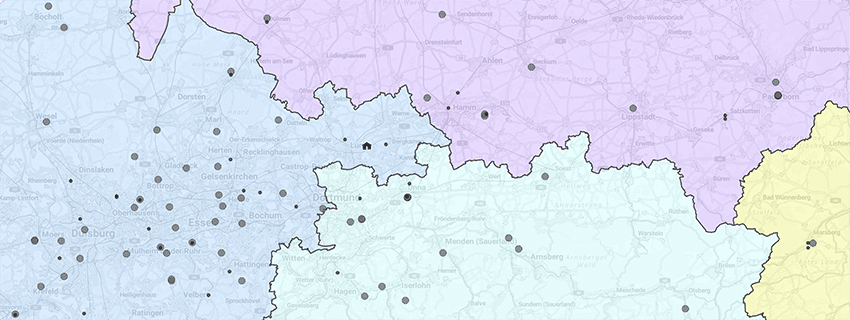
Many companies invest considerable resources in their sales and service – and miss out on potential because their territory structures no longer match the current reality. Historically grown territories, lack of review, lack of coordination: the errors in territory planning are often known, but are frequently underestimated – or only become apparent when the damage has already been done.
Before we take a closer look at these mistakes, it is worth taking a brief look at what territory planning actually means – and why it is so crucial to sales success.
What is territory planning?
Territory planning means the regional division of an overall territory into clearly defined sub-territories for the efficient management and use of resources. Resources include sales and service staff, branches, warehouses, service centers and marketing activities. The aim is to achieve the best possible coverage of the market area, improve customer service, minimise costs and increase sales.
easymap professional provides you with software that has been developed precisely for this task: Analyse, plan and optimise areas – data-driven and visually on the map.
What are the benefits of optimal territory planning?
Optimal alignment between resources and territories
By dividing territories according to the skills and resources of the sales or service employees, it is possible to ensure that they are deployed efficiently and that territory allocations are sustainable. When planning delivery areas, the aim is to minimise delivery times across all delivery and warehouse locations. Service centers and service areas can be planned in such a way that as many customers as possible can be served.
Increase sales and improve customer service
Dividing the market into territories means assigning a defined group of customers that can be reached as quickly as possible by a sales or service employee. Reduced travel times leave more time for personal on-site support, which in turn improves the customer relationship and leads to higher sales.
Flexibility
Thanks to the defined regional responsibility, potential new customers can be addressed very quickly and integrated into the usual sales processes. A regular review and adjustment of the regional structure allows us to react flexibly to changes in the market, customer structure, customer requirements or other influences and to keep the support strategy up to date at all times.
How do you implement territory planning effectively?
Effective territory planning is usually preceded by a number of processes that require close cooperation with other departments within the company.
Market analysis
A thorough analysis of the market to identify customer preferences and needs as well as potential opportunities and risks is essential. In addition to your own company data, it is advisable to consult other external data – depending on the business area. This can be socio-demographic characteristics, industry-specific indicators or B2B data, for example. easymap can be expanded with numerous market data that enable a well-founded evaluation of your areas. Topics such as customer segmentation and persona formation play a central role in modern sales structures.
Defining resources and targets
If the market and the target groups are known, these should be documented with corresponding visit frequencies and visit durations. There are two approaches: Either the availability of resources limits the possible number of visits, or the number of employees required results from the visit definitions.
In addition to these two central factors, there are many other framework conditions that should be taken into account – such as the skills of employees and customers, hierarchies, branch and network structures, historical backgrounds and local conditions. With easymap route planning, visit duration and travel times can be put in even better relation and round off an optimized territory structure. Our article How utilised is your sales force really?
The most common mistakes in territory planning
And so back to the starting point: Where do companies fail in practice? We encounter three mistakes particularly frequently.
Lack of communication and late involvement of stakeholders
Territory planning is not a purely analytical process – it is a process of change. A lack of communication and cooperation between different departments and the late involvement of stakeholders of all kinds – such as regional managers, the works council, marketing or office staff – often lead to a lack of acceptance for changes to territory structures. The best planning on paper is of little use if it is not supported in practice.
Lack of review and adjustment
Over time, a lack of review and adaptation – keyword: historically grown – means that the company is no longer able to continuously improve sales strategies and thus react to changes in the market.
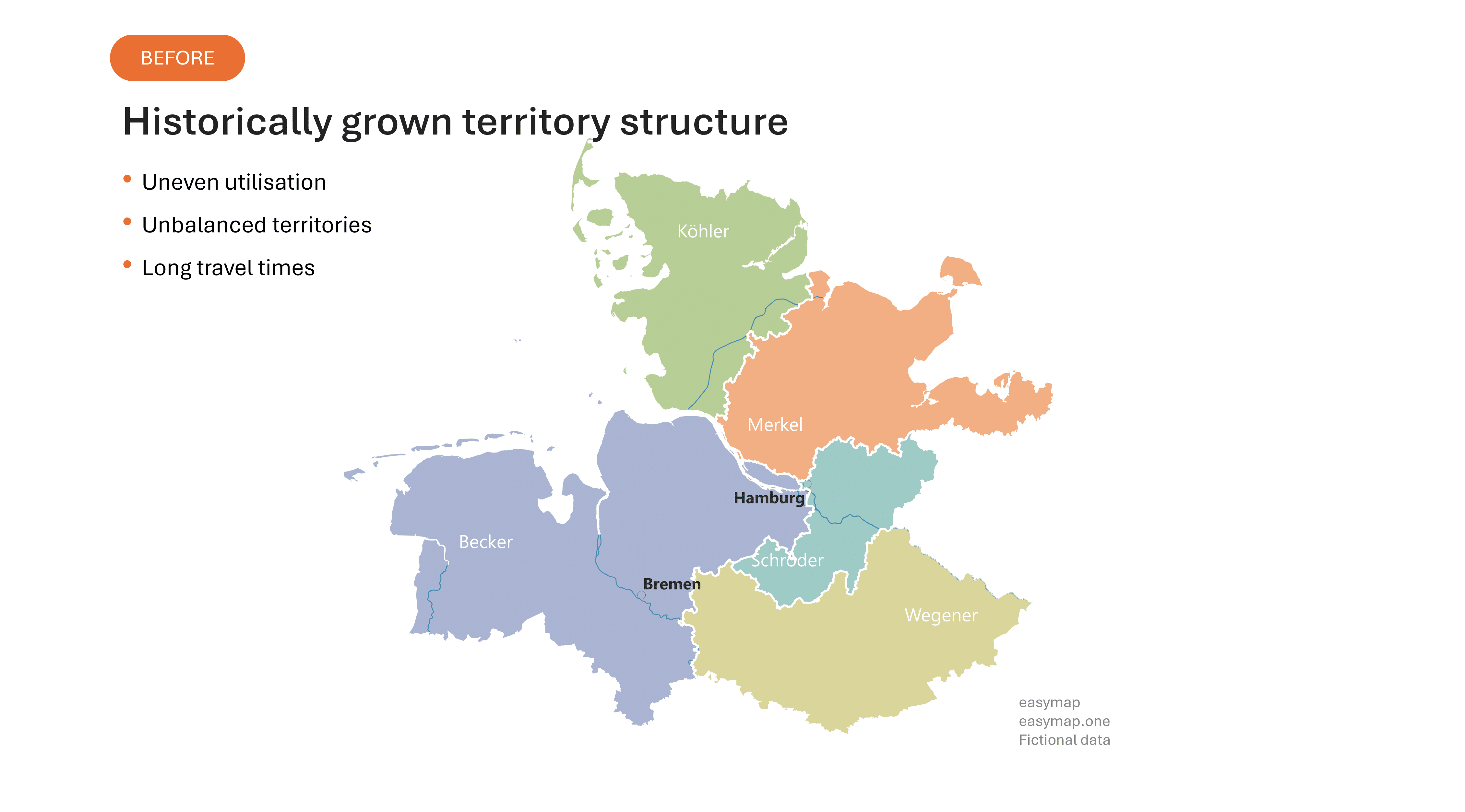
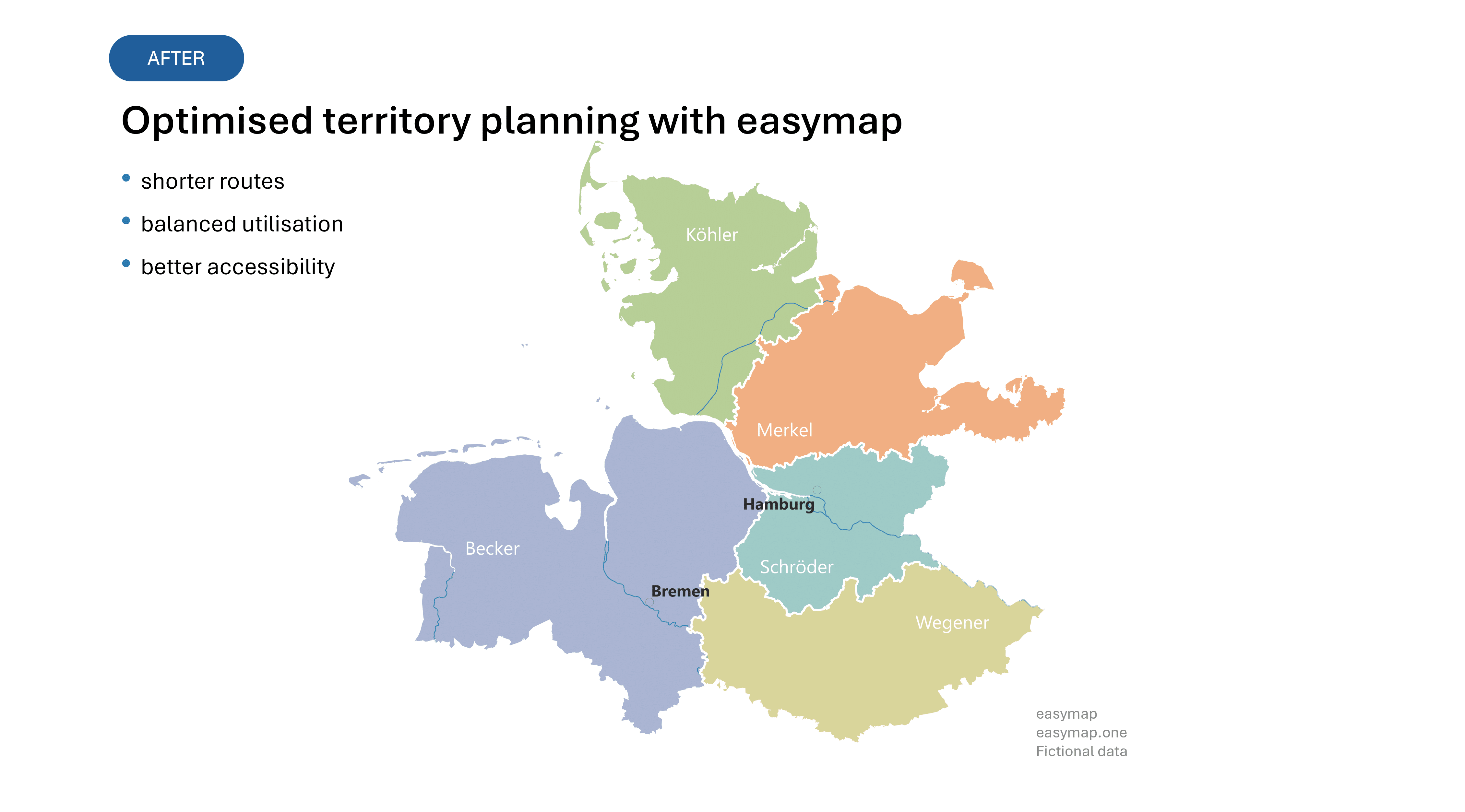
This often leads to an unbalanced use of resources and uneven customer service: individual employees are constantly working at their limits while others have free capacity. Data-based territory planning in the field service helps to make overloads and free capacity visible at an early stage.
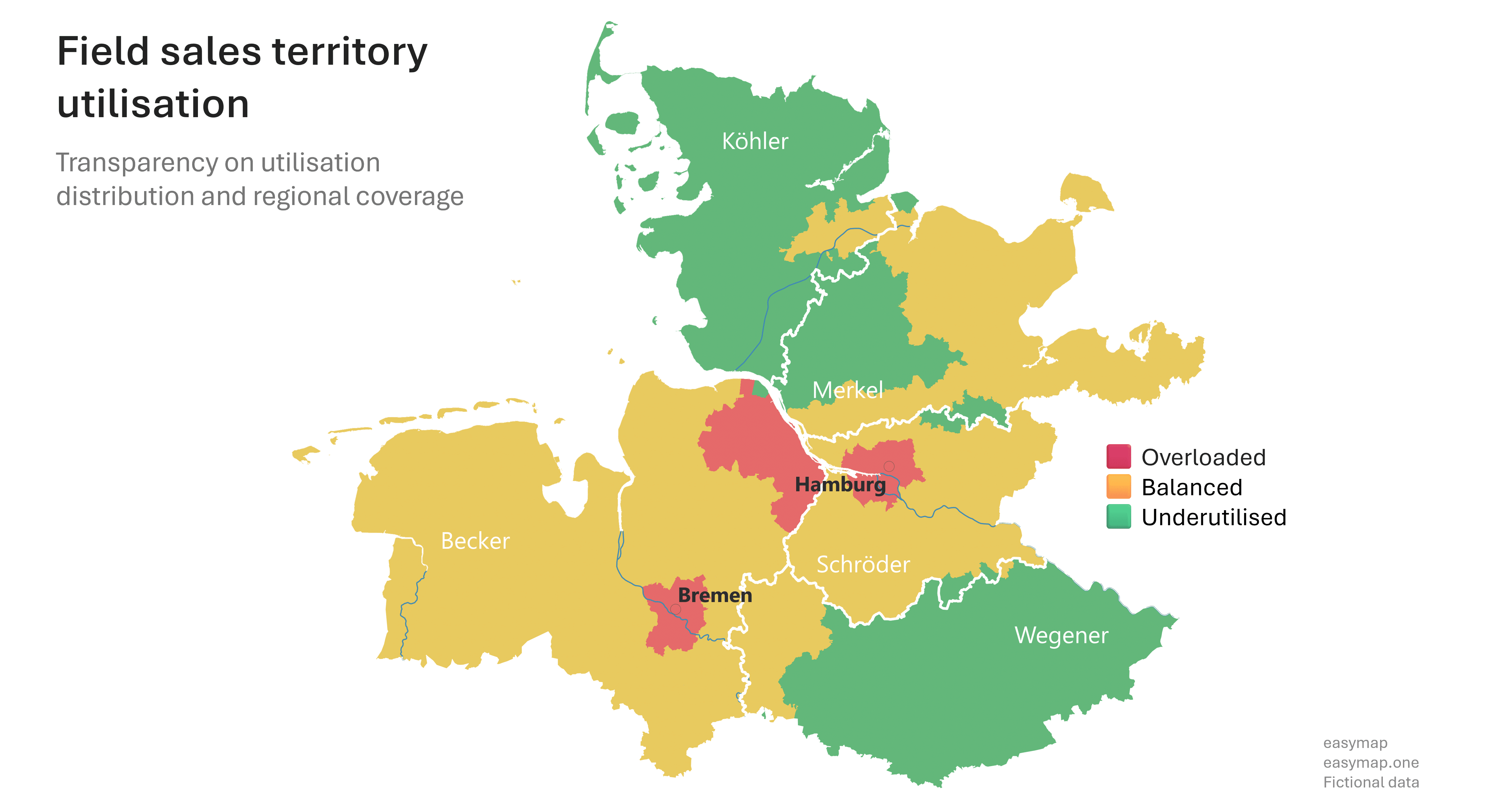
Typical weaknesses in sales force territory planning are often only recognised at a late stage. You can read more about how such imbalances can be made visible in our article How busy is your sales force really?
Insufficient customer segmentation
Particularly when market conditions or the company’s portfolio change, a lack of or inadequate customer segmentation means that employees are unable to respond appropriately to customers and make suitable offers. Territory planning is only as good as the database on which it is based. You can find an overview of possible applications with easymap – from customer segmentation to territory optimization – on our website.
Contact us for support with optimal territory structures
The requirements in territory planning are as diverse as there are sales and service employees in the market. We help you to bring sales and service closer to the customer – whether through our software, individual consulting and training or joint project support.
Simply contact us – by e-mail at consulting@infas360.de or by telephone on +49 228 9591491 – and we will work with you to develop your optimum territory structures. Or arrange an online presentation directly and see easymap in action.
Further information on our territory planning software can be found at easymap.one.
This post is also available in: DE