
Mapping the 2026 World Cup: Records, Teams and Travel Distances
The 2026 World Cup maps in easymap explorer provide a geographical overview of the biggest tournament in history—venues, groups, travel distances, and historical facts at a glance.
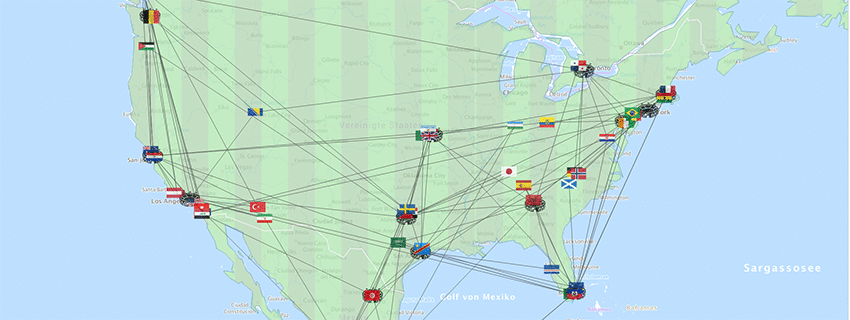
The 2026 FIFA World Cup is a tournament of extremes—and a perfect testing ground for geomarketing. For the first time, 48 nations will compete; for the first time, there will be three host countries; and for the first time, teams will have to travel distances on a scale never before seen at a World Cup.
The 2026 World Cup at a Glance
The Men’s World Cup will take place from June 11 to July 19, 2026, in the United States, Canada, and Mexico. With 48 teams, 104 matches, and 16 stadiums, the tournament breaks all previous records. The group stage consists of 12 groups of four teams each, with the top two teams from each group and the eight best third-place teams advancing to the knockout round.
The 16 venues are distributed as follows:
- United States: 11 stadiums (including New York/New Jersey, Los Angeles, Dallas, Atlanta, Miami, Houston, Seattle, Boston, Philadelphia, San Francisco, and Kansas City)
- Mexico: 3 stadiums (Mexico City, Monterrey, Guadalajara)
- Canada: 2 stadiums (Toronto, Vancouver)
The final will take place on July 19 at MetLife Stadium in East Rutherford, New Jersey.
Germany in Group E: Houston, Toronto, New York
In Group E, Germany will face Ecuador, Ivory Coast, and World Cup debutant Curaçao—three opponents from three different continents. On paper, advancing from the group is a must, but the opponents are formidable: Ivory Coast is the reigning African champion and qualified without conceding a single goal. Ecuador finished second in the South American qualifiers—behind Argentina, but ahead of Brazil and Uruguay. And Curaçao, the smallest World Cup participant in history with a population of 156,000, brings a team with strong Dutch soccer DNA.
From a geographical perspective, Germany has a long way to go: Houston, Toronto, and New York are far apart—a clear example of the scale of travel involved in this World Cup.
World Champions and Record-Holding Participants: Who Dominates World Cup History?
Since the first World Cup in Uruguay in 1930, only eight nations have won the title:
- Brazil – 5 titles (1958, 1962, 1970, 1994, 2002)
- Germany – 4 titles (1954, 1974, 1990, 2014)
- Italy – 4 titles (1934, 1938, 1982, 2006)
- Argentina – 3 titles (1978, 1986, 2022)
- France – 2 titles (1998, 2018)
- Uruguay – 2 titles (1930, 1950)
- England – 1 title (1966)
- Spain – 1 title (2010)
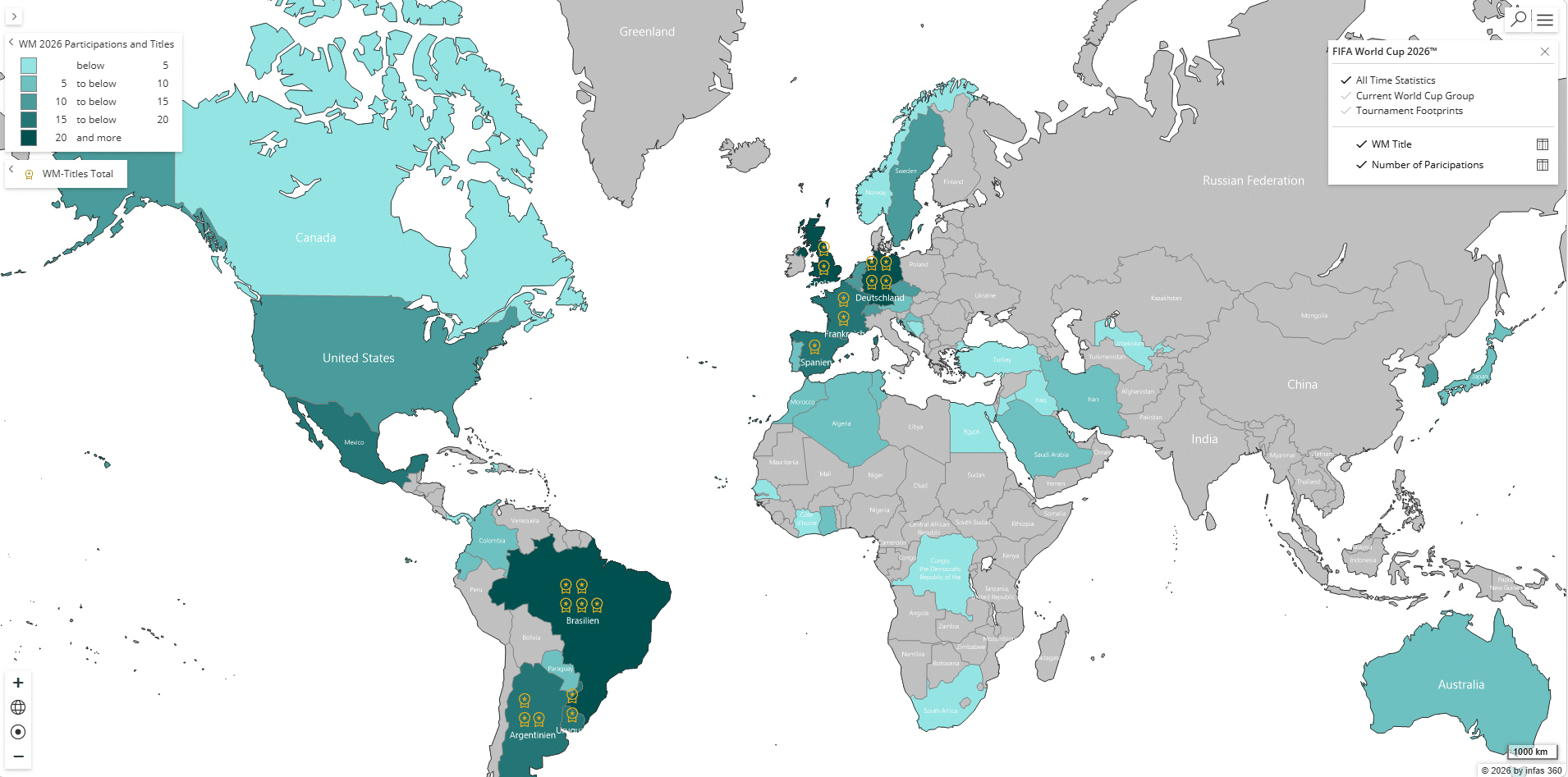
In easymap explorer, the historical dominance of individual soccer nations can be visualized geographically. The map shows at a glance how strongly the history of the World Cup has been shaped by countries from Europe and South America. Despite numerous World Cup appearances, no nation from Africa, Asia or North America has ever won the World Cup title.
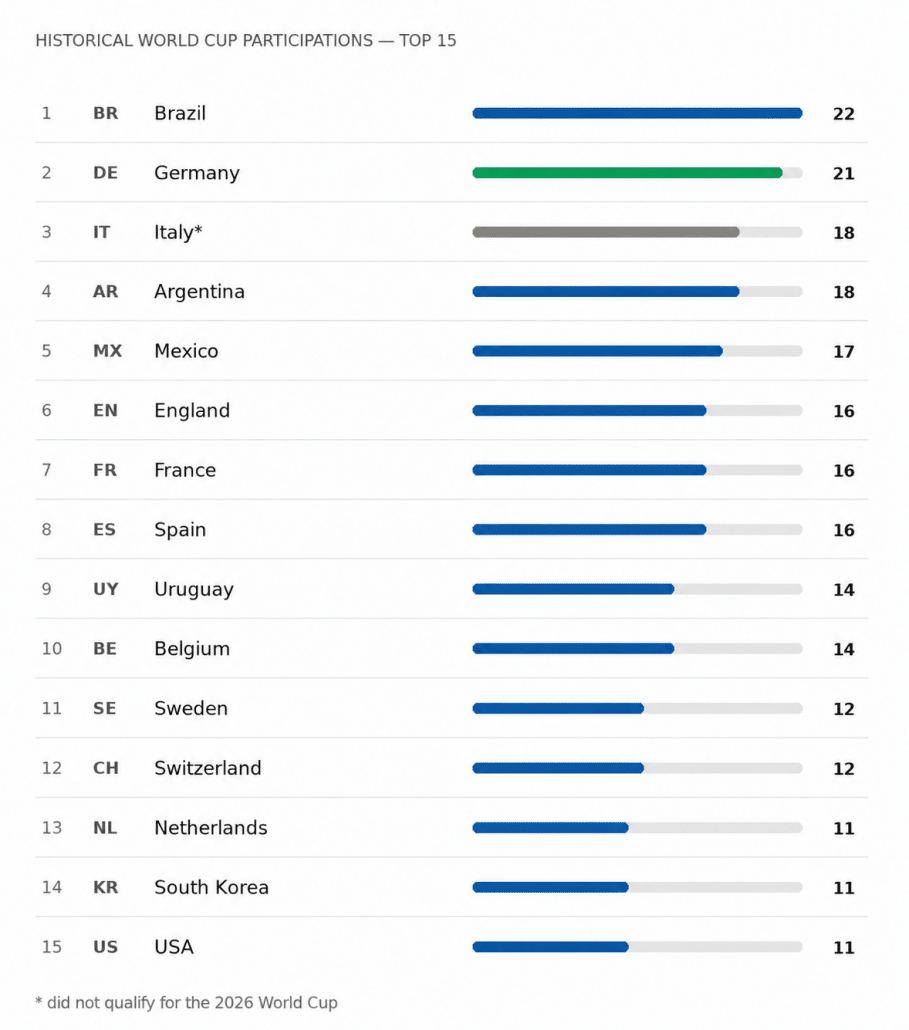
The traditional soccer nations also dominate in terms of World Cup appearances. Brazil will be making its 22nd appearance in a final round at the 2026 World Cup, making it the sole record participant. Germany follows with its 21st participation. They are followed by Italy and Argentina with 18 appearances each.
The following table shows the 15 nations with the most World Cup participations since 1930. Particularly noteworthy: Italy, four-time world champions and third in the historic ranking of participants, will not be represented in 2026 either. The Squadra Azzurra will therefore miss out on its third World Cup in a row.
The Travel Challenge: How Far Do Teams Have to Travel?
Perhaps the most exciting geomarketing topic of this World Cup: the extreme travel distances. Some teams have to travel thousands of kilometers through three host countries and 16 venues across North America.
A relationship analysis in easymap explorer makes it clear which teams have the longest routes:
- Asian and Oceanian teams such as Australia, Japan and South Korea not only have the longest journeys from their home countries, but also play at venues that are sometimes far away from each other during the group stage.
- Although European teams have the longest journey across the Atlantic, they sometimes benefit from conveniently located venues within a geographical region.
- South American teams such as Brazil and Argentina have a comparatively shorter journey – and play at venues in the southern USA and Mexico, where the climate is more familiar to them.
FIFA has deliberately divided the venues into geographical regions (North, Central, South) in order to minimize the travel burden. You can see at a glance on our map whether this has been successful – and once again shows how much can be gained from geographical data if it is visualized correctly.
Where Geomarketing Meets Soccer
The 2026 World Cup is not only a tournament of superlatives in sporting terms, but also exceptional from a geographical perspective. Three host countries, 16 venues and 48 nations make for exciting spatial connections that often remain hidden in traditional tables or match schedules.
The interactive maps in easymap explorer make historical records, participant structures and team travel routes visible at a glance. This example shows how geomarketing and map analyses can help to visualize complex data in an understandable way and open up new perspectives on familiar topics.
Map credits: © 2026 by infas 360, © Federal Agency for Cartography and Geodesy 2026, Data source (data modified)
This post is also available in: DE